Automation Readiness Assessment


Discover if your organisation is ready for business automation.


What this tool does

This assessment evaluates your organisation's readiness for business automation across three key dimensions: process maturity (how well-documented and consistent your processes are), technology foundation (your current systems and integration capabilities), and organisational readiness (team attitudes and resources available).

Answer honestly for the most useful results. This takes approximately 3 minutes.

How this assessment works

Our methodology is based on industry-standard automation readiness frameworks used by leading technology consultancies and research firms. The assessment evaluates your organisation across three dimensions that research shows are the strongest predictors of automation success:

Process maturity

You can't automate chaos. Documented, consistent processes provide the foundation.

Technology foundation

Clean data and connected systems enable automation to work effectively.

Organisational readiness

Team buy-in, resources, and clear goals determine whether automation delivers value.

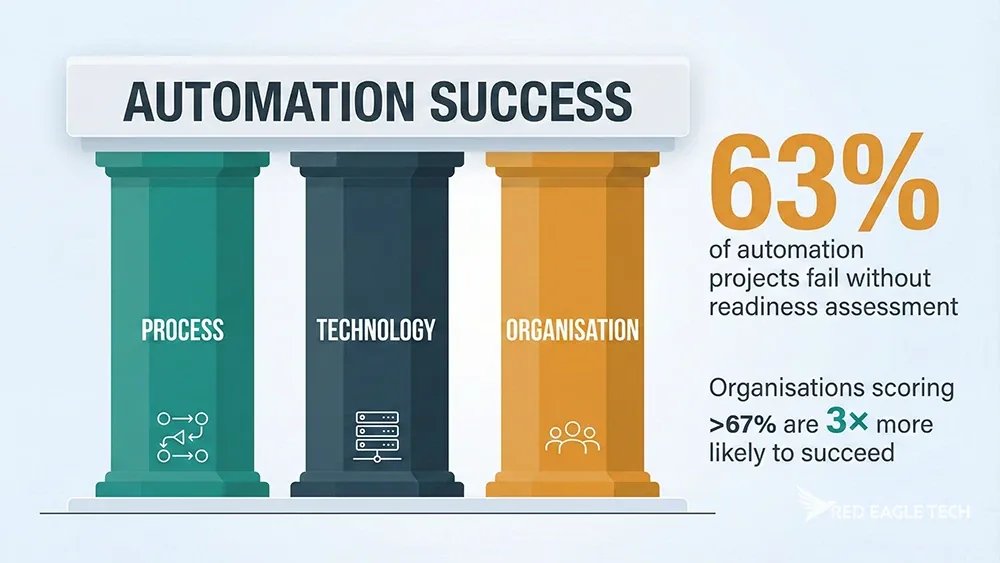
Research shows that organisations scoring above 67% are three times more likely to achieve automation success within 12 months.
Automation readiness assessment

The three pillars of automation success: Process, Technology, and Organisation
Automation success is built on three foundations: process maturity, technology foundation, and organisational readiness.

Discover your automation readiness

Answer 9 quick questions to assess your organisation's readiness for business automation across three dimensions: process, technology, and organisation.

Takes approximately 3 minutes

Question 1 of 9 Process Maturity

Process maturity

How well documented are your current business processes?

Process maturity

How consistent are your business processes?

Process maturity

How often do your core processes change?

Technology foundation

What business software do you currently use?

Technology foundation

How well do your current systems work together?

Technology foundation

How clean and reliable is your business data?

Organisational readiness

How would your team react to automation changes?

Organisational readiness

What resources can you dedicate to automation?

Organisational readiness

How clear are your automation goals?


Your automation readiness results

Overall readiness
0%

Process maturity
0%

Technology foundation
0%

Organisational readiness
0%

Our recommendation

Want to discuss your results with an automation expert?

Book a free consultation

Understanding the three dimensions

Process maturity

How well-documented and consistent your processes are. Automation works best when processes are stable, well-understood, and followed consistently across the organisation.

How to improve: Document your key workflows step-by-step. Map who does what, when, and why. Identify bottlenecks before trying to automate them.

Technology foundation

Your current systems and how well they integrate. Clean data and connected systems provide the foundation for effective automation.

How to improve: Audit your data quality: fix duplicates, inconsistencies, and gaps. Choose systems with APIs that can connect to other tools.

Organisational readiness

Team attitudes, available resources, and clarity of goals. Even the best technology fails without buy-in and proper change management.

How to improve: Involve your team early - listen to their concerns and ideas. Define clear success metrics before starting any project.

How UK businesses compare

Understanding where you stand relative to other UK businesses helps put your results in context. According to 2024-2025 research:

15%

of small UK businesses (<50 employees) have implemented automation

34%

of medium UK businesses (50-249 employees) use automation

68%

of large UK businesses (250+) have adopted automation

The bottom line: Research shows that 63% of businesses attempting automation without a readiness assessment experience delayed ROI or project failure. Taking time to assess your readiness significantly improves your chances of success.

When to use this tool

  • Before investing - Understand your readiness before committing to automation projects
  • Strategic planning - Identify which areas need improvement before automation can succeed
  • Vendor discussions - Get a clear baseline to discuss with automation solution providers
  • Progress tracking - Re-assess quarterly as you address gaps and improve readiness

Frequently asked questions

Simple automations like email workflows and chatbots can be deployed in 2-4 weeks. Workflow automation across multiple systems typically takes 6-12 weeks. Key factors affecting timeline include data quality, integration complexity with existing systems, and team readiness for change.

RPA (Robotic Process Automation) follows strict rules to mimic human actions: clicking buttons, entering data, moving files. It works best for repetitive, predictable tasks. AI automation can make decisions, handle unstructured data like emails and documents, and learn from patterns. Many organisations combine both approaches for comprehensive automation.

Focus on high-volume, repetitive tasks with clear documentation and predictable patterns. Good first candidates include invoice processing, data entry, report generation, and customer email responses. Look for processes that consume significant employee time and are prone to human error. Start small to build confidence before tackling complex workflows.

A low score isn't failure - it's valuable information. Focus on the dimension with the lowest score first. Process maturity issues often require documenting key workflows before automating. Technology gaps may need data cleanup or system integration work. Organisational readiness benefits from team engagement, clear communication, and defining specific goals.

Entry-level no-code platforms like Zapier start from around £20/month. Typical SME workflow automation projects range from £500 to £30,000 depending on complexity. Most businesses achieve ROI within 6-12 months, with documented returns of 200-500% for well-chosen projects. Start with a small pilot to prove value before larger investments.

Modern no-code platforms have significantly reduced technical barriers. The most valuable skills are understanding your business workflows, documenting processes clearly, and managing change effectively. Only 19% of employees currently have formal automation training, so you're not alone in learning. Many businesses start with simple tools and build expertise over time.

Ready to start your automation journey?

Get a free consultation with our automation experts. We'll review your assessment results and help you plan your next steps.

Book your free consultation

Our partners

Microsoft Partner logo
Shopify Partners logo
QuickBooks logo
CrowdStrike logo
Check Point logo
NinjaOne logo
Axcient logo
Perimeter 81 logo

Our tech stack

C# logo

C#

.NET logo

.NET

Node.js logo

Node.js

React JS logo

React JS

Blazor logo

Blazor

SignalR logo

SignalR

Azure logo

Azure

Azure App Service logo

App Service

Azure Functions logo

Functions

GitHub logo

GitHub

Azure DevOps logo

DevOps

Azure Bicep logo

Bicep

Azure SQL logo

Azure SQL

MongoDB logo

MongoDB

OneLake logo

OneLake

Kafka logo

Kafka

Power BI logo

Power BI

Microsoft Fabric logo

Fabric

Azure AI Foundry logo

AI Foundry

Copilot logo

Copilot

OpenAI logo

OpenAI

Anthropic logo

Anthropic

Playwright logo

Playwright

Cloudflare logo

Cloudflare