
Agile vs waterfall: A buyer's guide to how your software gets built
Read more
Senior-led delivery, fixed-price commitments and pricing that reflects how we're built - for software, SEO, web design and managed IT support.
We combine the budget certainty of fixed-price contracts with the flexibility of agile delivery - at competitive pricing, because we're built lean. You know what you're paying, you see senior delivery on every project, and you get work that actually solves your business problems. Most of our work is bespoke software, but the same principles apply across SEO, web design and managed IT support. Want to learn more about who we are? Read about us.

You know the cost upfront. We take on the estimation risk, not you. Swap features in and out without paying extra.
See and test your solution before it's built. Wireframes and interactive prototypes validate requirements early.
Real users test throughout development. We build what people actually need, not what we think they need.
Working software every two weeks. Regular demos, continuous progress, and you're always in the loop.
Let's address the elephant in the room: many business owners are understandably nervous about agile's reputation for open-ended costs. "You'll know the final price when it's done" doesn't work for anyone running a business with real budget constraints.
That's why we lead with fixed-price agile. You get the budget certainty of a traditional fixed-price contract, but with the flexibility to adapt as you learn. If you discover halfway through that Feature A is more important than Feature B, you can swap them. The total cost stays the same - you just get the features that matter most.
We invest in thorough upfront discovery - understanding your business, documenting requirements, creating wireframes, and estimating effort. This is typically a fixed-price engagement of its own, so you know your investment before we start.
Based on discovery, we provide a fixed-price proposal for the development work. You know the total cost upfront. No surprises, no open-ended hourly billing, no "it depends" answers.
We build using agile methods - sprints, regular demos, continuous feedback. You can reprioritise features, swap things in and out - but you don't pay extra. We absorb the risk of estimation, not you.
We're incentivised to get it right because our profit depends on delivering efficiently. You're incentivised to engage because you get better software. Win-win.
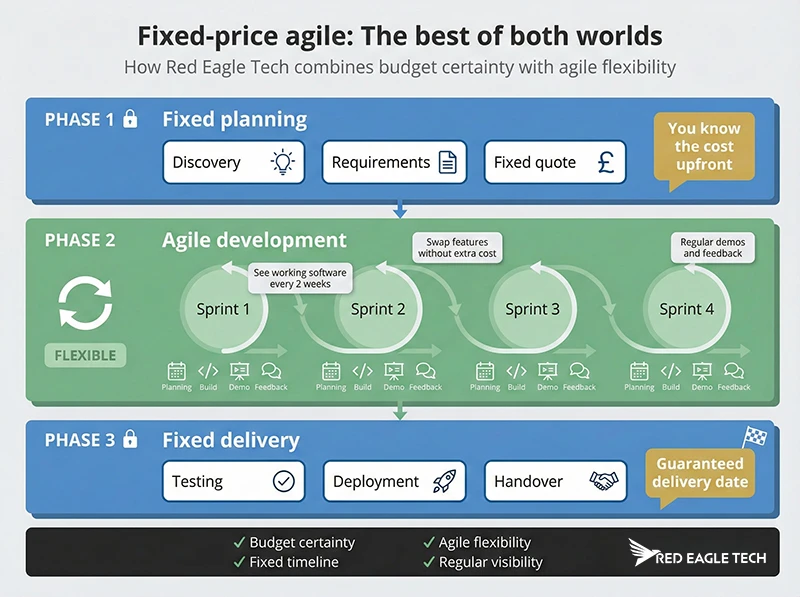
Why this works: You get the predictability of traditional contracts with the adaptability of agile. Changes to scope become conversations about priorities rather than negotiations about cost.
One of the most powerful techniques in modern development is rapid prototyping - creating interactive simulations of your software before writing production code. This dramatically reduces the risk of building the wrong thing.
Simple, black-and-white layouts showing page structure, navigation, and information hierarchy. These help validate that we've understood your requirements before investing in visual design.
Clickable mockups that simulate the user experience. You can walk through key workflows, test with real users, and refine before development begins.
Stakeholders and end-users can react to something tangible rather than abstract requirements. Misunderstandings surface when changes are cheap.
Research consistently shows that problems caught during prototyping cost a fraction to fix compared to problems discovered after development. It's one of the best investments in any software project.
We involve real end-users throughout development through what we call our User Panel approach. Rather than building software in isolation and hoping users like it, we gather continuous feedback from the people who will actually use the system.
Users react to prototypes before development begins, catching issues when changes are cheapest.
Selected users test new features at the end of each sprint, providing real-world feedback.
Real-world testing of workflows and user experience with your actual target users.
User insights directly inform backlog prioritisation and guide development decisions.
This approach ensures the software works for the people who need to use it every day - not just the stakeholders who signed off on requirements.
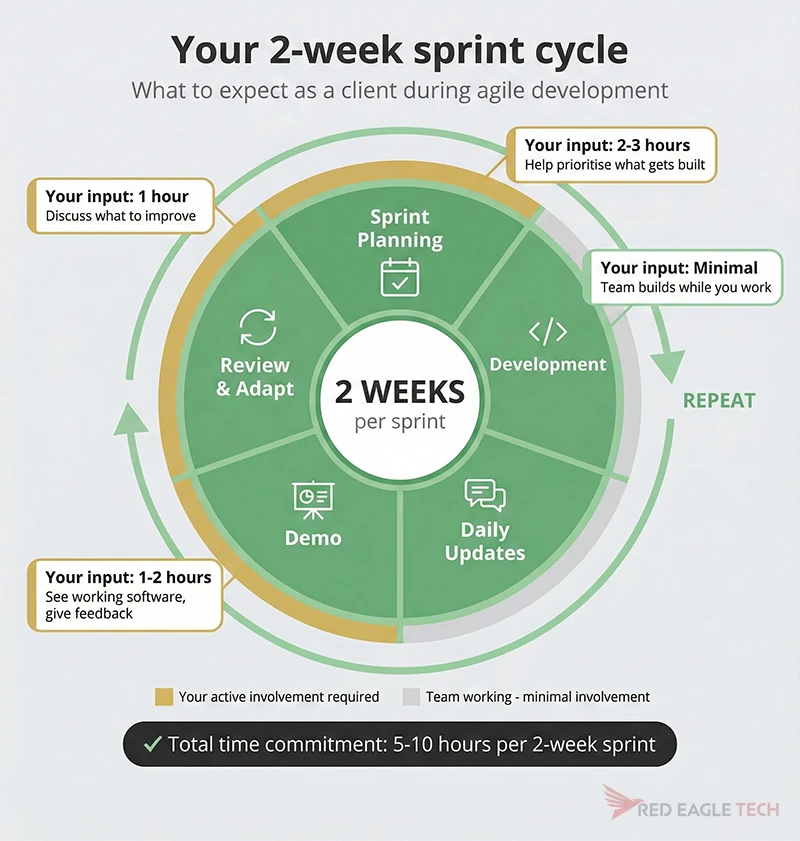
We work in two-week sprints, which means you see working software every fortnight. Here's what each sprint looks like from your perspective:
| When | What happens | Your involvement |
|---|---|---|
| Day 1 | Sprint planning - agree what will be built this sprint | 1-2 hours: Review priorities, answer questions |
| During sprint | Team builds features, tests continuously | Available for questions (email/Slack) - typically 30 mins |
| Day 10 | Sprint review - demo of completed work | 1 hour: See the demo, provide feedback |
| After review | Backlog updated based on your feedback | Optional: Discuss priority changes |
Your typical time commitment: 3-5 hours per sprint (every two weeks). It's more than traditional waterfall, but significantly less than full-time project management - and the results are dramatically better because you're steering continuously.
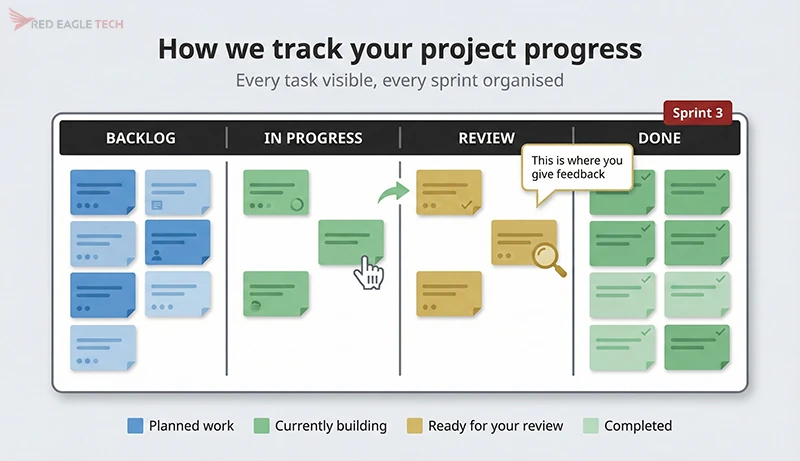
Transparency is central to how we work. Here's what you can expect to receive at each stage of your project.
Four structural choices that shape how we deliver - and why our pricing reflects how we're built.
Staffed by 100% senior engineers. Directors deliver client work directly and stay 75% billable - over twice the industry typical of 33%. You're paying for senior delivery, not a pyramid markup.
Routine work accelerated by AI; every output reviewed and signed off by a senior engineer. Client data never passed to AI tools without express agreement.
Independent and 100% family-owned since our founding in 2024. No external shareholders, no exit-driven margin pressure. Aligned with you, not with a sale timeline.
Built on Microsoft's .NET, the enterprise framework used by HMRC, the NHS and UK banks. Every solution we ship is either actively maintained or decommissioned - no legacy drift, no growing tech debt overhead.
The London premium myth. BenchPress 2025 found London £1m+ agencies pay senior salaries 20% above non-London but only manage to charge clients 14% more - leaving them roughly 5% less gross profit than regional peers. The premium is real, but it's mostly absorbed into salary inflation, not channelled to additional client value. We avoid that squeeze structurally.
We're a North London agency, but we don't charge London prices. That's not because we cut corners - it's because we're built differently. Seven structural choices keep our cost base lean, and we pass the saving on through competitive pricing rather than padding margins.
| Cost line | Typical London £1m+ agency | Red Eagle Tech |
|---|---|---|
| Office rent (per sq ft) | £100-£200+ (City core to Mayfair prime) | ~£15-£25 (Barnet North London tech corridor) - 5-9× cheaper |
| Senior staff cost | +20% London premium; only +14% charge premium achieved | We avoid the structural London salary squeeze through senior-weighted hiring + remote-first model |
| Senior:junior ratio | Junior-heavy pyramid (33% director utilisation; 75% junior) | 100% senior team |
| Director utilisation (billable %) | ~33% industry typical | 75% billable - over 2× industry typical |
| Remote-first model | 50%+ industry typical (just under 5% are full-time office) | 60% remote with a small, economical Barnet footprint |
| External shareholder return | Required (PE-backed or holding company); 58% of agency owners actively prioritising sale | None - 100% family-owned since our founding in 2024 |
| Own-marketing PPC | Industry typical for growth funding | 0% - zero PPC. 100% in-house marketing via SEO, outreach and word-of-mouth |
| Tech stack and maintenance | Mixed stacks; legacy accumulates as old projects pile up | Standardised on Microsoft's .NET (the same enterprise framework used by HMRC, NHS and UK banks); non-negotiable maintenance discipline - solutions are actively kept current or decommissioned, never left to drift |
We're based in the Barnet tech corridor in North London, where average office rents run roughly £15-£25 per square foot - around 9× cheaper than Mayfair prime (£200+) and 5× cheaper than the City core (£100+). Combined with our remote-first model - 60% of the team works remotely, in line with the industry trend (SparkToro 2024) - we run on a small footprint at a fraction of central London office cost.
Most agencies run a junior-heavy pyramid: lots of cheap juniors supervised by directors who only stay 33% billable on client work (BenchPress, via Synergist). We've built differently - 5 senior engineers, no juniors, with our directors at 75% billable on real client work. You're paying for senior delivery, not a pyramid markup.
We're family-owned and independent. No external shareholders, no private equity backing, no exit-driven margin pressure. Industry context: PE investment in marketing agencies is up 21% year-on-year and 58% of UK agency owners are actively prioritising sale (BenchPress 2025) - the consolidation trend is accelerating. We're the structural exception, and that means our pricing reflects fair client value rather than the return demands of external capital.
We spend zero on paid search advertising. 100% of our marketing is in-house via SEO and contact list building - both low-cost, compounding assets that build over time rather than getting rented from Google. Many agencies fund growth through paid search, and that cost gets passed through to clients. Ours doesn't.
We hire selectively for engineering judgement and stay small. A team of 100% senior engineers means fewer hand-offs, less coordination overhead and senior decision-making at every step. Industry revenue per head sits around £95k (Moore Kingston Smith 2025); ours is materially higher because we don't carry the junior-plus-supervision overhead.
We use AI for routine work that doesn't need senior judgement - freeing our engineers for the parts that do. MIT/GitHub field experiments measured a 26% productivity uplift from AI-augmented developer work (n=4,867); Microsoft's Future of Work research shows 10-14% gains across document and customer-service tasks (and 34% for less-experienced staff). Used as a tool by our experienced senior engineers - not as a substitute for them - this raises quality rather than compromises it. Routine work goes to AI; our engineers spend more time on the parts that matter most: deeper testing, harder architecture decisions, the judgement calls AI can't make. The uplift shows up as both stronger work and more competitive pricing.
We use supervised AI for: code completion, rapid prototyping and experimentation, research and summarisation, first-draft documentation, test scaffolding, routine data transformations, meeting summaries and image generation.
We don't use AI for: production code without test coverage and senior review, client-facing copy without senior rewrite, security-sensitive logic, final architectural decisions, final design or UX decisions, strategic recommendations to clients or anything that would replace senior judgement.
Every deliverable that touches your project is reviewed and signed off by a named senior engineer or director.
Client data: we don't pass any client data to AI tools unless expressly agreed.
No training: client data is never used to train external models.
Our primary stack is Microsoft's .NET - the enterprise framework used by HMRC, the NHS and UK banks. It's a proven, well-supported choice that ages gracefully and stays hireable. Just as importantly, our maintenance discipline is non-negotiable: every solution we build is either kept actively maintained and current, or decommissioned. There's no middle ground where things drift into legacy. We're transparent about that - clients pay a clear ongoing maintenance arrangement upfront, not silent technical debt building up in the background.
The cost of getting this wrong is enormous: typical UK SMEs spend around 70% of their IT budget keeping the lights on rather than innovating, and Stripe's research shows developers lose 42% of their time to technical debt - roughly two days every week. We don't carry that overhead, and our clients don't either. Here's our full analysis of the true cost of technical debt.
These principles apply across everything we do - explore the full range below.
Tell us what you need. We'll get back to you within 2 business hours. No pushy sales tactics, just a friendly conversation.
Get in touch


