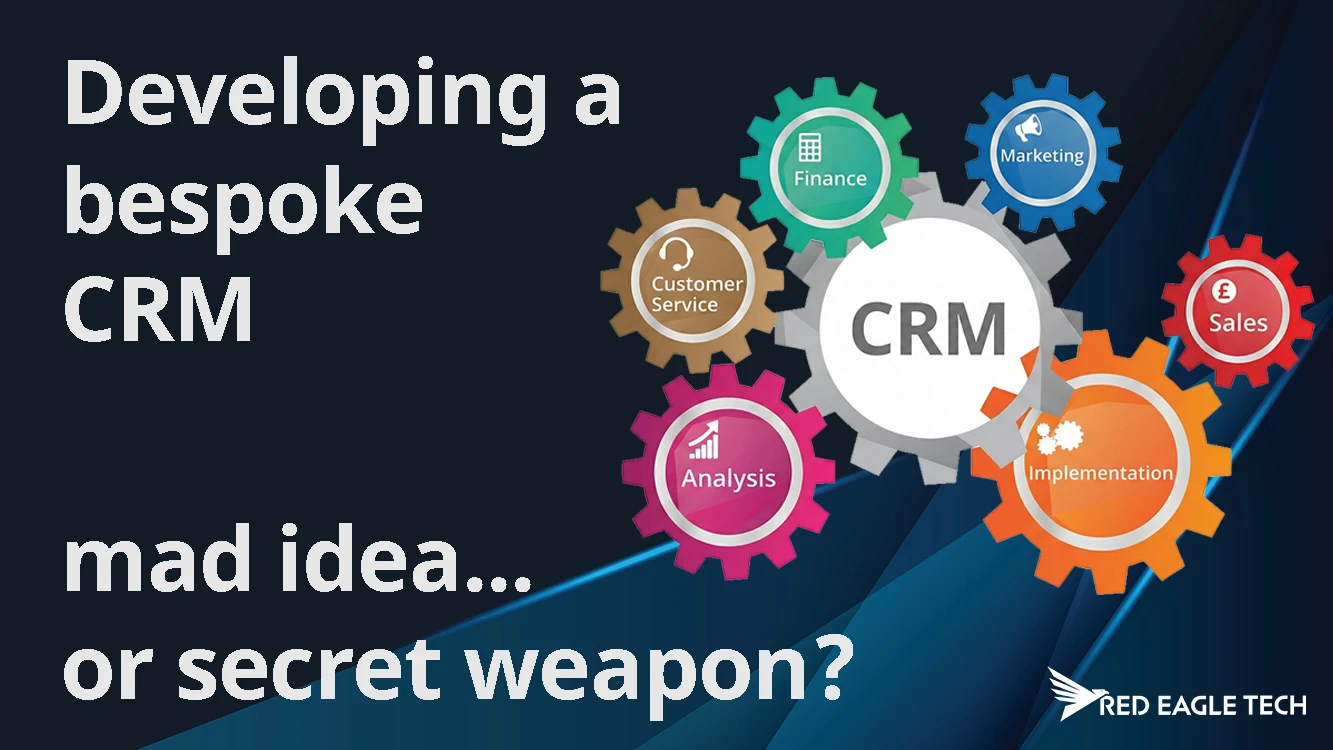
Quick answer: Bespoke CRM development in the UK costs between £20,000 and £300,000+ depending on complexity. Development typically takes 2-8 months for most business applications. A custom CRM makes sense when off-the-shelf solutions like Salesforce or HubSpot don't fit your unique business processes, or when you need specific integrations that packaged software can't provide.
Your customer relationships are the lifeblood of your business. But if you're wrestling with a CRM that doesn't quite fit how you work, you're not alone. Plenty of UK businesses find themselves paying for features they'll never use while missing the specific functionality they actually need.
That's where bespoke CRM comes in. A custom-built system designed around your exact business processes, not the other way around.
This guide covers everything you need to know about bespoke CRM development in the UK: what it involves, when it makes sense, how much it costs, and how to find the right development partner. Whether you're frustrated with your current CRM or exploring options for the first time, you'll find practical answers here.
What is a CRM system?
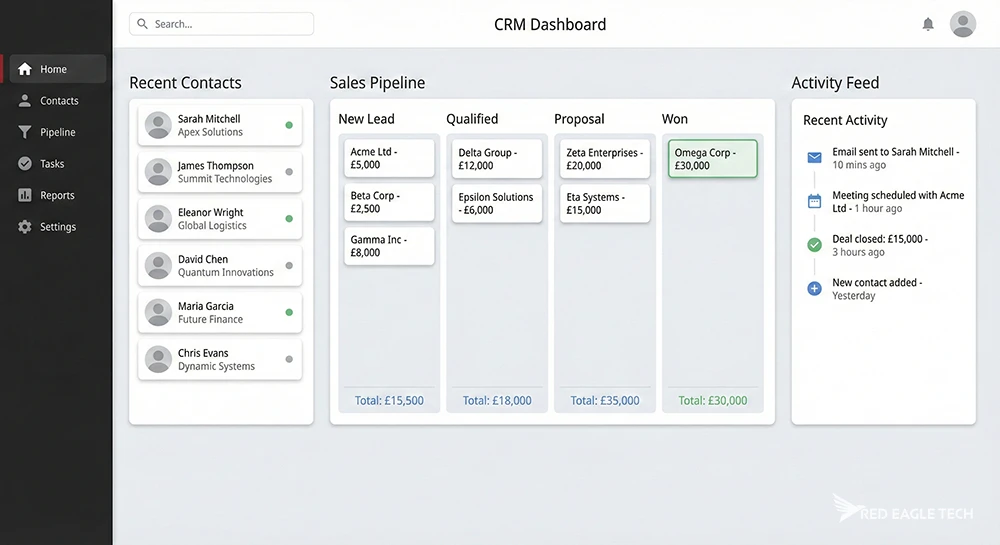
A CRM (Customer Relationship Management) system is software that helps you manage, track, and store information about your customers and prospects in one centralised place. Think of it as a single source of truth for every interaction your business has with its customers.
Instead of customer details scattered across spreadsheets, email inboxes, and sticky notes, a CRM brings everything together. When someone calls with a question, anyone on your team can instantly see their full history: previous purchases, past conversations, outstanding quotes, and any notes from colleagues.
Core CRM functionality
Contact management
Store and organise customer details, communication preferences, and relationship history in one searchable database.
Sales pipeline tracking
Monitor deals through every stage from initial enquiry to closed sale, with clear visibility of your sales forecast.
Task and activity management
Never miss a follow-up with automated reminders, task assignments, and activity logging for calls, meetings, and emails.
Reporting and analytics
Turn customer data into insights with dashboards showing sales performance, customer behaviour, and team productivity.
Workflow automation
Automate repetitive tasks like sending follow-up emails, updating records, or assigning leads to team members.
Integration capability
Connect with your other business tools, from email and calendars to accounting software and marketing platforms.
A growing number of UK SMEs also extend their CRM with AI-powered contract management - tracking customer agreements, renewal dates and obligations alongside the customer record. See our AI contract management guide for UK businesses for how this works in practice.
The UK CRM market in 2026
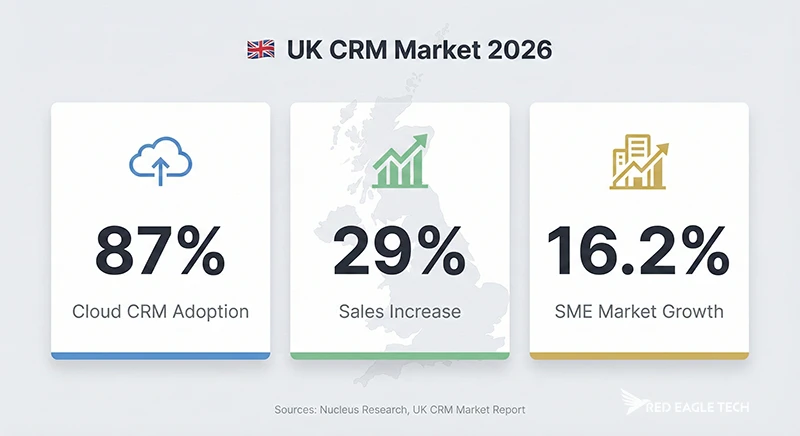
The UK CRM software market continues to grow rapidly. According to recent market research, the UK CRM market reached £3.47 billion in 2024 and is projected to grow at 9-11% annually through 2030. This growth is driven by increasing digitisation, the shift to cloud-based solutions, and businesses recognising the competitive advantage of better customer relationships.
What's particularly interesting is the shift towards bespoke solutions. While giants like Salesforce and HubSpot dominate the market, more UK businesses are discovering that a tailored system built for their specific needs can deliver better value than paying premium prices for features they'll never use.
Bespoke vs off-the-shelf CRM
The choice between bespoke CRM and off-the-shelf solutions like Salesforce, HubSpot, or Microsoft Dynamics is one of the most important technology decisions you'll make. Both approaches have their place, but choosing wrong can cost your business significantly in money, time, and frustration.
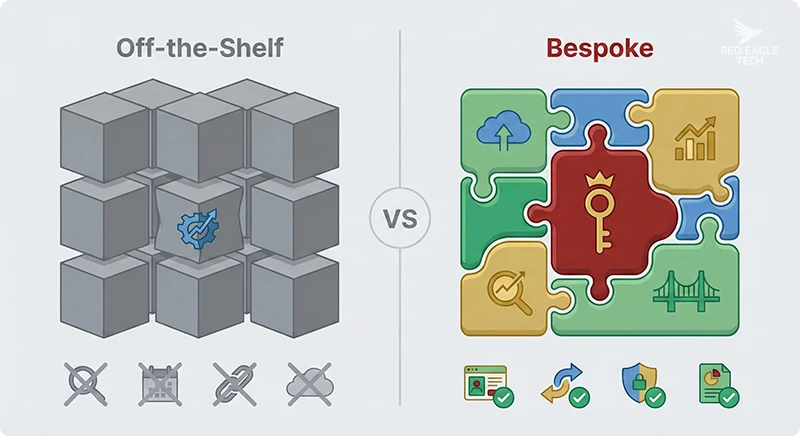
The fundamental difference? Off-the-shelf CRM systems are pre-built solutions designed to serve multiple industries and business types. Bespoke CRM systems are custom-built around your specific workflows and processes. With off-the-shelf, you adapt your business to fit the software. With bespoke, the software adapts to fit your business.
Head-to-head comparison
| Factor | Off-the-shelf CRM | Bespoke CRM |
|---|---|---|
| Customisation | Limited to vendor's design and configuration options | Fully customisable to your exact needs |
| Flexibility | Constrained by vendor roadmap and release cycles | Adjustments and modifications anytime |
| Scalability | May require expensive tier upgrades or migration | Designed to grow with your business |
| Data ownership | Subject to vendor terms and conditions | Complete ownership and control |
| Integration | Standard integrations; extras cost more | Seamless integration with any system |
| Implementation time | Days to weeks | 2-8 months typical |
| Upfront cost | Low or no initial cost | £20,000-£300,000+ |
| Ongoing cost | Escalating subscription fees over time | Predictable maintenance fees |
| Feature relevance | Feature bloat with unused functionality | Only features you need |
The hidden cost problem with off-the-shelf CRM
Off-the-shelf CRM looks attractive on paper. Low upfront costs, quick deployment, famous brand names. But the total cost picture often tells a different story.
Consider a typical scenario: You sign up for Salesforce or HubSpot at £50-150 per user per month. Seems reasonable for a team of 10. But then:
- You need an integration with your accounting software: £200/month extra
- You want custom reports: need the higher tier, add £30/user/month
- Your team grows to 25 people: costs triple
- You need specific workflow automation: enterprise tier only, £150/user/month
- Five years later, you're paying £50,000+ annually for software that still doesn't quite fit
Meanwhile, a bespoke CRM built for £60,000 with £10,000 annual maintenance would have cost you £110,000 over the same period, while doing exactly what you need, nothing more, nothing less.
The subscription trap: Many UK businesses find that the long-term cost of off-the-shelf CRM, including subscriptions, add-ons, and workarounds, exceeds what bespoke development would have cost. Always calculate the 5-year total cost of ownership before deciding.
When off-the-shelf makes sense
Off-the-shelf CRM isn't always the wrong choice. It works well when:
- Your processes are standard - You follow widely accepted industry practices without significant customisation needs
- You need something immediately - Rapid deployment within days or weeks is critical
- Your team is small - Per-user costs are manageable with fewer than 5-10 users
- Basic functionality suffices - Contact management, simple pipeline tracking, and email integration cover your needs
- Budget is tightly constrained - You genuinely can't afford the upfront investment in bespoke development
For many startups and small businesses in their early stages, an off-the-shelf CRM provides good-enough functionality while you figure out your exact requirements. You can always move to bespoke later when you've outgrown the limitations.
When your business needs bespoke CRM
Not every business needs a custom CRM. But there are clear signs that indicate when bespoke development makes sense for your organisation.
Signs you've outgrown off-the-shelf CRM
You're building workarounds
Your team has created elaborate spreadsheets, manual processes, or external tools to compensate for what your CRM can't do. This hidden labour costs more than you realise.
You're paying for unused features
Your subscription includes hundreds of features, but you use only 20% of them. You're effectively subsidising functionality designed for other industries.
Integration is painful
Connecting your CRM to other business systems requires expensive third-party tools, and data still doesn't flow smoothly between systems.
Your team resists using it
Staff find the CRM confusing, slow, or irrelevant to how they actually work. Low adoption means you're not getting the value you're paying for.
Your processes are unique
Your business has developed distinctive workflows that differentiate you from competitors. Generic CRM forces you into generic processes.
You're scaling rapidly
Per-user licensing costs are becoming unsustainable as your team grows, and you need a system that scales without proportional cost increases.
Industries where bespoke CRM excels
Certain industries consistently find that bespoke CRM delivers better value than off-the-shelf alternatives:
- Property and estate agents - Complex property matching, viewings management, chain tracking, and portal integrations
- Financial services - Regulatory compliance, risk assessment workflows, and client portfolio management
- Manufacturing - Order configuration, production scheduling integration, and technical specification tracking
- Healthcare providers - Patient pathways, appointment scheduling, and clinical integration
- Professional services - Matter management, time tracking, and complex relationship mapping
- Wholesale and distribution - Trade accounts, credit limits, pricing tiers, and inventory integration
The decision framework
Use this simple framework to guide your decision:
Choose bespoke when...
- Your business processes are genuinely unique
- You need specific integrations with existing systems
- Data control and ownership are critical
- You're planning significant growth
- Custom features provide competitive advantage
- You can invest £20k+ upfront for long-term value
Choose off-the-shelf when...
- Standard CRM processes fit your workflow
- You need a solution within days, not months
- Your team is small (under 10 users)
- Basic CRM functionality is sufficient
- Budget is your primary constraint
- You're still figuring out your exact requirements
Not sure which way to go? Many UK businesses start with off-the-shelf CRM, identify its limitations through real use, then commission bespoke development with clear requirements. There's no shame in starting simple and upgrading when you understand your needs better.
Key features of a bespoke CRM
Every bespoke CRM is different because every business is different. However, there are essential features that form the foundation of any effective CRM system, plus advanced capabilities you might want to consider.
Essential features (the foundation)
These core capabilities should be in every bespoke CRM:
| Feature | What it does | Business benefit |
|---|---|---|
| Contact management | Centralised database storing all customer and prospect information with full interaction history, communication preferences, and relationship details. | 360° view of every customer. No more hunting through emails or asking colleagues. |
| Sales pipeline | Visual representation of deals moving through stages from initial enquiry to closed sale, with probability weighting for forecasting. | Clear visibility of sales performance and accurate revenue forecasting. |
| Task and activity management | Track calls, meetings, emails, and follow-up tasks. Automated reminders ensure nothing falls through the cracks. | Improved customer service. Every commitment is tracked and fulfilled. |
| Email integration | Automatic logging of email conversations to customer records. Send emails directly from CRM with templates and tracking. | Full communication history visible to anyone who needs it. Faster response times. |
| Reporting and dashboards | Real-time visibility of key metrics: sales performance, pipeline health, activity levels, customer acquisition costs. | Data-driven decisions. Identify issues early. Celebrate wins. |
| User permissions | Role-based access controls ensuring staff see only what they need. Protect sensitive customer data. | Security and compliance. Appropriate data access for each role. |
Advanced features (worth considering)
Depending on your needs and budget, these features can significantly enhance your CRM's value:
Workflow automation
Automate repetitive tasks: lead assignment, follow-up emails, status updates, approval workflows. Studies show automation can reduce admin time by 20%+.
Best for: Teams drowning in manual processes
Marketing automation
Email campaigns, lead nurturing sequences, newsletter management, and campaign tracking integrated with your sales pipeline.
Best for: Businesses with significant marketing activity
Customer portal
Self-service portal where customers can view their account, raise support tickets, access documents, and update their details.
Best for: Service businesses with ongoing customer relationships
Mobile access
Access your CRM from phones and tablets. Update records, log calls, and check customer info while on the move.
Best for: Field sales teams and mobile workers
AI-powered insights
Lead scoring, next best action recommendations, sentiment analysis, and predictive analytics to prioritise effort.
Best for: Data-rich businesses wanting to optimise performance
Quote and proposal generation
Create professional quotes directly from CRM with product catalogues, pricing rules, and e-signature integration.
Best for: Sales teams sending regular proposals
Integration requirements
The value of bespoke CRM multiplies when it connects seamlessly with your other business systems. Here are common integrations for UK businesses:
Accounting software
Sage, Xero, QuickBooks, FreeAgent. Sync invoices, payments, and customer financial data.
Email and calendar
Microsoft 365, Google Workspace. Log emails, sync calendars, schedule meetings.
Marketing tools
Mailchimp, HubSpot Marketing, Campaign Monitor. Sync contacts and track campaign engagement.
E-commerce platforms
Shopify, WooCommerce, Magento. Sync orders, customers, and product data.
Telephony systems
Click-to-call, call logging, screen pops with customer info when calls arrive.
ERP systems
SAP, Microsoft Dynamics, NetSuite. Two-way sync of orders, inventory, and customer data.
Looking for Microsoft Dynamics? We're an official Microsoft Dynamics partner. Our Business Central service offers enterprise-grade ERP at SMB-friendly prices, with up to 30% savings on implementation. See how much you could save or get in touch to discuss your requirements.
Security and GDPR compliance
Any CRM handling UK customer data must comply with GDPR and maintain robust security. Bespoke CRM has an advantage here because compliance can be built in from day one, rather than retrofitted to a generic system.
GDPR requirements your CRM should address
- Consent tracking: Record when and how consent was given
- Right to access: Export all data held about an individual
- Right to deletion: Remove data on request (with audit trail)
- Data minimisation: Only collect what you actually need
- Audit logging: Track who accessed what and when
- Breach notification: Processes for reporting incidents
Security features to expect
- Role-based access: Staff see only what they need
- Encryption: Data encrypted in transit and at rest
- Two-factor authentication: Extra login security
- UK data centres: Data stays in UK jurisdiction
- Regular backups: Protection against data loss
- Security updates: Ongoing patching and maintenance
Pro tip: Don't try to include every possible feature in your initial build. Start with the essentials, launch, then add advanced features based on actual usage and feedback. This keeps costs down and ensures you're building what you truly need.
The bespoke CRM development process
Understanding what to expect during CRM development helps you plan effectively and work productively with your development partner. Here's a typical process, though good agencies will adapt this to your specific situation.
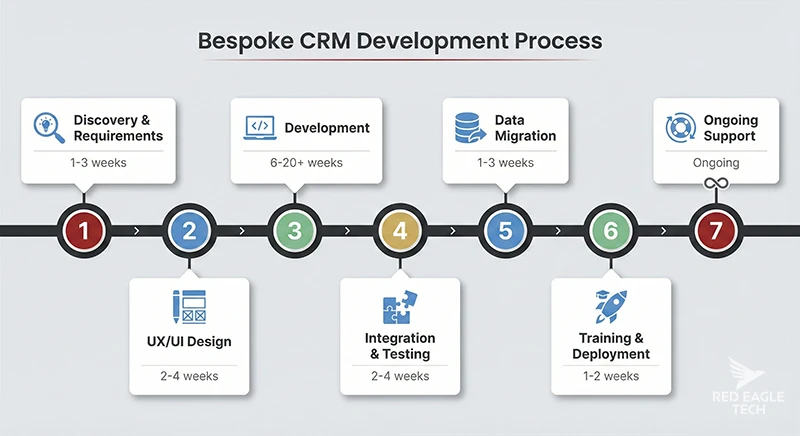
Discovery and requirements gathering
Duration: 1-3 weeks
The development team works closely with you to understand your business goals, current processes, pain points, and what success looks like. This typically involves workshops, interviews with key staff, and analysis of your existing systems. The output is a detailed specification document that defines exactly what will be built.
UX/UI design and prototyping
Duration: 2-4 weeks
Designers create wireframes and visual designs for your CRM interface. You'll see clickable prototypes that demonstrate how the system will work before any code is written. This is your chance to refine the user experience and ensure the design matches how your team actually works.
Development (in sprints)
Duration: 6-20+ weeks (depending on complexity)
The development team builds your CRM in 2-week sprints, delivering working functionality incrementally. You'll see regular demos and have opportunities to provide feedback throughout. This agile approach means you're not waiting months to see results, and changes can be incorporated as you learn more about what works.
Integration and testing
Duration: 2-4 weeks
Your CRM is connected to other business systems (accounting, email, marketing tools, etc.) and thoroughly tested. This includes functional testing, user acceptance testing with your team, performance testing, and security testing. Any issues are identified and resolved before launch.
Data migration
Duration: 1-3 weeks
Existing customer data from spreadsheets, old CRM systems, or other sources is cleaned, mapped, and imported into your new CRM. This is often more complex than it sounds, as data quality issues need to be resolved and relationships between records maintained.
Training and deployment
Duration: 1-2 weeks
Your team is trained on how to use the new CRM effectively. The system is deployed to production, often in a phased approach starting with a pilot group before rolling out to the entire organisation. Documentation and user guides are provided for ongoing reference.
Ongoing support and enhancement
Duration: Ongoing
After launch, the development team provides support to resolve any issues and make refinements based on real-world usage. Most businesses also plan for ongoing enhancements as they identify new opportunities to improve the system.
Timeline by project complexity
| Complexity | Typical timeline | What you get |
|---|---|---|
| Basic CRM | 2-4 months | Core contact management, simple pipeline, basic reporting, 1-2 integrations |
| Mid-complexity CRM | 4-8 months | Full sales and service functionality, multiple integrations, custom workflows, mobile access |
| Enterprise CRM | 8-18 months | Complex multi-department system, advanced automation, AI features, customer portal, extensive integrations |
Pro tip: Consider a phased approach. Start with core functionality (contact management, pipeline, basic reporting), launch that, then add advanced features in subsequent phases. This gets you to value faster and allows requirements to evolve based on actual usage.
How much does bespoke CRM cost in the UK?
One of the most common questions we hear from UK businesses exploring bespoke CRM. Here's a transparent breakdown of realistic costs for 2026, based on current UK market rates and our experience delivering CRM projects.
If you're newer to the topic, our foundational guide on what bespoke software is covers how it differs from off-the-shelf and SaaS, when it genuinely makes sense for UK businesses, and what to look for in a development partner. For detailed information about bespoke software costs more broadly, including developer rates and pricing models, see our full UK cost guide.
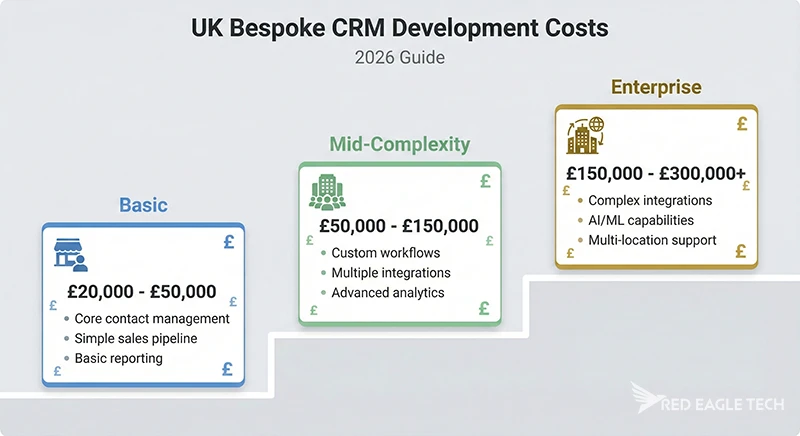
Cost ranges by complexity
| Complexity level | Cost range | Typical features |
|---|---|---|
| Basic CRM | £20,000 - £50,000 | Contact management, sales pipeline, basic reporting, email integration, single user role |
| Mid-complexity CRM | £50,000 - £150,000 | Above plus: workflow automation, multiple integrations (accounting, marketing), custom dashboards, mobile access, role-based permissions |
| Enterprise CRM | £150,000 - £300,000+ | Above plus: AI-powered features, customer portal, advanced analytics, complex multi-department workflows, extensive third-party integrations, high availability |
What affects the cost?
Number of features
Each additional feature module (marketing automation, customer portal, inventory integration, etc.) adds development time and cost.
Integration complexity
Connecting to well-documented APIs (Xero, Mailchimp) is straightforward. Integrating with legacy systems or poorly documented services takes more effort.
Data migration
Moving clean, well-structured data is simple. Migrating messy data from multiple sources with inconsistent formatting is significantly more work.
Design requirements
Standard business interface vs highly polished customer-facing design with extensive branding requirements affects design and development time.
Security and compliance
GDPR compliance is standard. Additional requirements like ISO 27001, PCI DSS for payments, or healthcare compliance add complexity.
User volume
Systems designed for 10 users vs 500 users require different architectural considerations, affecting both development and hosting costs.
Additional costs to budget for
The development cost is just part of the picture. Here are the ongoing costs you should plan for:
| Cost type | Typical range | Notes |
|---|---|---|
| Hosting | £600 - £3,000/year | Cloud hosting (Azure, AWS). Scales with usage and data storage. |
| Maintenance | 15-20% of build cost/year | Bug fixes, security updates, minor enhancements, technical support. |
| Third-party services | £0 - £500/month | Email delivery (SendGrid), SMS, mapping, payment processing fees. |
| Training | £500 - £2,000 | Initial user training. Well-designed systems minimise this. |
| Data migration | £2,000 - £10,000 | Often included in project, but complex migrations may be extra. |
| Future enhancements | 20-30% of build cost in Year 1 | Once live, you'll identify improvements and new features to add. |
Total cost of ownership example
A £60,000 mid-complexity CRM project might have annual costs of: £1,500 hosting + £10,000 maintenance + £1,000 third-party services = £12,500/year. Over 5 years: £60,000 build + £62,500 running = £122,500 total. Compare this to £50/user/month for 20 users of off-the-shelf CRM: £12,000/year × 5 years = £60,000 for basic functionality that doesn't fit your processes and requires constant workarounds.
Fixed-price vs time and materials
How you're charged for CRM development significantly impacts your budget certainty and risk:
Fixed-price (recommended)
How it works: You agree a total price upfront based on detailed specifications. The agency delivers the agreed scope for that price, regardless of how long it takes.
Best for: Most CRM projects, especially first-time software buyers who need budget certainty. If the project takes longer than estimated, that's the agency's problem, not yours.
Time and materials
How it works: You pay for actual time spent at agreed day/hourly rates. Final cost depends on how long development actually takes.
Best for: Projects where requirements are genuinely uncertain, or long-term partnerships where you want maximum flexibility. You carry the risk of overruns.
Our approach at Red Eagle Tech: We offer fixed-price quotes as standard for CRM projects as part of our bespoke software development services. After a thorough discovery phase, you know exactly what you'll pay. If we underestimate the work, we absorb the difference. This gives you budget certainty and aligns our incentives with delivering efficiently. Learn more about our pricing approach.
Choosing a CRM development partner
The success of your bespoke CRM project depends heavily on choosing the right development partner. A poor choice can result in a system that doesn't meet your needs, costs more than expected, or worse, never gets finished at all.

What to look for in a CRM development partner
Relevant experience
Have they built CRM systems before? Even better, have they worked with businesses in your industry or of similar size? Ask for case studies and references from comparable projects.
Team composition
Who will actually work on your project? Meet the team, not just the sales people. Understand their experience levels and whether they'll be dedicated to your project or juggling multiple clients.
Communication style
Are they responsive? Do they explain technical concepts clearly? You'll be working together for months, so communication fit matters enormously. How quickly do they respond during the sales process?
Pricing model
Do they offer fixed-price contracts for budget certainty, or only time and materials? Understand how changes during the project will be handled and priced.
Post-launch support
What happens after go-live? Understand their support arrangements, response times, and ongoing maintenance options. A CRM needs ongoing care to remain valuable.
Location and availability
Are they UK-based? Working with a UK team means shared timezone, cultural understanding, and easier collaboration. Consider whether face-to-face meetings will be beneficial.
Questions to ask potential partners
- Can you show me examples of CRM systems you've built? Look for evidence of relevant experience and ask to speak with previous clients.
- Who specifically will work on my project? Don't accept vague answers. You want to know names, experience levels, and availability.
- How do you handle scope changes during development? Changes are inevitable. Understand the process and cost implications upfront.
- What happens if the project runs over budget or time? With fixed-price, this shouldn't affect you. With T&M, understand the risks.
- How will you ensure my team actually uses the system? Technology is only valuable if people use it. Good partners think about adoption from day one.
- What's your discovery process? Be wary of partners who jump straight to proposals without thoroughly understanding your business.
- How long will you support the system after launch? Understand the ongoing relationship and what's included.
Red flags to watch for
Warning signs
- Reluctance to provide references
- Pressure to sign quickly
- Vague answers about team or process
- No discovery phase in their approach
- Promising unrealistic timelines or costs
- Offshore subcontracting without disclosure
- No clear support arrangements
Good signs
- Happy to provide references
- Ask lots of questions about your business
- Transparent about their process and team
- Thorough discovery before quoting
- Realistic about timelines and challenges
- Clear about who does the work
- Defined support and maintenance options
Don't choose on price alone. The cheapest quote is rarely the best value. A poor implementation can cost far more in wasted time, lost productivity, and the eventual need to start again. Focus on total value and confidence in delivery, not just the headline number.
Common mistakes to avoid
Learning from others' mistakes can save you significant time and money. Here are the pitfalls we see most often in bespoke CRM projects, and how to avoid them.
1. Unclear requirements
The mistake: Starting development without a clear, documented specification of what you need.
The fix: Invest time in a proper discovery phase. Document requirements thoroughly. Get sign-off from all stakeholders before development begins.
2. Scope creep
The mistake: Continuously adding "just one more feature" during development, causing delays and cost overruns.
The fix: Agree a fixed scope for Phase 1. Keep a "Phase 2" list for good ideas that emerge. Stick to the plan.
3. Building without users
The mistake: Designing the CRM based only on management requirements without involving the people who'll actually use it daily.
The fix: Include frontline users in requirements gathering and testing. Their input is invaluable for adoption.
4. Big bang launches
The mistake: Trying to build and launch everything at once, leading to long waits before any value is delivered.
The fix: Launch in phases. Get core functionality live quickly, then add features based on real feedback.
5. Neglecting training
The mistake: Assuming people will figure out the new system on their own. They won't, or they'll use it badly.
The fix: Budget for proper training. Identify champions who can support colleagues. Provide ongoing resources.
6. Underestimating data migration
The mistake: Treating data migration as an afterthought. Messy data creates messy CRM.
The fix: Plan data migration early. Clean your data before importing. Test thoroughly with real data.
7. Choosing on price
The mistake: Selecting the cheapest quote without considering quality, experience, or long-term value.
The fix: Evaluate total value. Consider the cost of getting it wrong and having to start again.
8. No maintenance plan
The mistake: Treating launch as the end. Without ongoing maintenance, the system quickly becomes outdated and unreliable.
The fix: Budget for ongoing maintenance from day one. Plan for continuous improvement based on usage.
Frequently asked questions
Bespoke CRM development in the UK typically costs:
- Basic CRM: £20,000 - £50,000 (core features, simple integrations)
- Mid-complexity: £50,000 - £150,000 (full functionality, multiple integrations, mobile access)
- Enterprise: £150,000 - £300,000+ (advanced features, AI, complex workflows)
Costs vary based on feature requirements, integrations needed, and data migration complexity.
Typical timelines:
- Basic CRM: 2-4 months
- Mid-complexity: 4-8 months
- Enterprise: 8-18 months
These include discovery, design, development, testing, and deployment. A phased approach can get core functionality live faster while additional features follow.
Choose bespoke when: your processes are unique, you need specific integrations, you want to avoid escalating subscription costs, or off-the-shelf requires too many workarounds.
Choose off-the-shelf when: standard processes work for you, you need immediate deployment, your team is small, or budget is very limited.
Yes, bespoke CRM can be excellent value for small businesses when:
- Off-the-shelf solutions don't fit your workflow
- You're paying for features you don't use
- You need specific integrations with existing systems
- Per-user licensing is becoming expensive as you grow
Many UK SMEs find a focused bespoke CRM at £25,000-£50,000 delivers better long-term value than paying £100-500 per user monthly for enterprise platforms that don't quite fit.
Yes, integration capability is one of the main advantages of bespoke CRM. Common integrations include:
- Accounting: Sage, Xero, QuickBooks, FreeAgent
- Email: Microsoft 365, Google Workspace
- Marketing: Mailchimp, HubSpot, Campaign Monitor
- E-commerce: Shopify, WooCommerce, Magento
- ERP: SAP, Microsoft Dynamics, NetSuite
Integration cost and complexity depend on the APIs available. Modern cloud services typically integrate easily; legacy systems may require more work.
Plan for these annual costs after launch:
- Hosting: £600 - £3,000/year depending on scale
- Maintenance: 15-20% of build cost annually
- Third-party services: Variable (email delivery, SMS, etc.)
- Future enhancements: Budget 20-30% of build cost in Year 1
A £50,000 CRM typically costs £10,000-£15,000 per year to maintain and host properly. This is usually still cheaper than equivalent off-the-shelf licensing at scale.
Key factors to evaluate:
- Relevant CRM development experience
- Portfolio with similar projects
- Fixed-price contracts for budget certainty
- UK-based team for communication ease
- Clear post-launch support arrangements
- Positive client references
Avoid choosing solely on price. Quality issues and project failures cost far more than paying a bit more for a reliable partner.
Bespoke CRM can be built with GDPR compliance from the ground up, which is actually an advantage over off-the-shelf systems. Key compliance features include:
- Consent tracking and management
- Right to access (data export)
- Right to deletion (with audit trail)
- Data minimisation by design
- Comprehensive audit logging
- UK data centre hosting
A good development partner will build GDPR compliance into the architecture rather than treating it as an afterthought.
Absolutely, and we often recommend this approach. Benefits include:
- Lower initial investment and risk
- Faster time to value
- Learning what you actually need through real usage
- Spreading costs over time
The key is building with future expansion in mind. A well-architected system can grow from core functionality to comprehensive platform without requiring a complete rebuild.
Next steps
Ready to explore whether bespoke CRM is right for your business? Here's how to move forward.
1. Assess your needs
Document your current CRM pain points, the features you actually need, and how a CRM would improve your operations. This clarity helps when talking to potential partners.
2. Estimate your budget
Use our cost estimator to get a ballpark figure. Consider both build cost and ongoing running costs over 5 years.
3. Talk to experts
Have a conversation with a development partner who can advise whether bespoke is right for you. A good partner will be honest if off-the-shelf would better serve your needs.
Ready to discuss your CRM project?
Get a free, no-obligation consultation with our team. We'll help you understand whether bespoke CRM is right for your business and provide a fixed-price quote if you decide to proceed.
Free consultation
30-minute call to understand your needs
Fixed-price quote
Clear costs with no hidden surprises
No obligation
Take your time to decide
Final thoughts
Bespoke CRM development is a significant investment, but for the right business, it delivers exceptional value. A system built specifically for how you work, integrated seamlessly with your other tools, and owned entirely by you.
The key is making an informed decision. Understand when bespoke makes sense (and when it doesn't), budget realistically for both build and ongoing costs, and choose a development partner you trust to deliver.
If you've made it through this guide, you're now better informed than most businesses starting their CRM journey. Use that knowledge to ask the right questions, avoid common pitfalls, and build a system that genuinely transforms how you manage customer relationships. A bespoke CRM can be a key component of your broader digital transformation roadmap.
Good luck with your project. And if you'd like to discuss your specific situation, we're always happy to help.